 Entrar

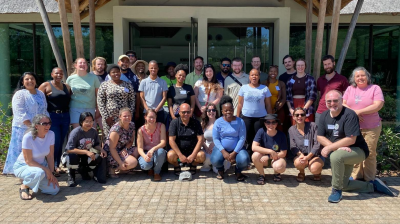
BioDATA Advanced Course on data use with GBIF
- eLearning, Sanbigbif |
BioDATA Advanced Course on Data Use with GBIF
Date: 18 – 21 November 2024
Venue: Kruger National Park, South Africa
Course Description
BioDATA Advanced is an international project between Norway and South Africa that aims to support students in higher education in developing skills in biodiversity data management and publishing, in addition to the most modern molecular methods for monitoring biodiversity. The skills taught within BioDATA Advanced are important for carrying out the everyday tasks of a modern biologist, though many of these skills are not taught in higher education.
This project also aims to strengthen the partnership between the South African Node of the Global Biodiversity Information Facility (SANBI-GBIF) and the other BioDATA partners through exchanges and enhanced collaborations on scientific projects of mutual interest.
This course is a practical, hands-on introduction to how to extract, manipulate, and use data from GBIF for scientific analysis. The in-person course included three days on learning some data use fundamentals and techniques, with an exciting field-work session, and some more thematic discussions on data use, and project showcases from Norway and South Africa.
The course covers aspects like Data Standards, Open Science Fundamentals, Fitness for Use, Data Cleaning, and Manipulation, as well as delving into the use and application of biodiversity data, to understand the value of data in science and policy.
Audience
The course is suitable for MSc and PhD students in biology and other early-career professionals in relevant fields. Participants should have an affinity or professional interest in biodiversity. Participants need to have the motivation and interest to use biodiversity data, and in particular GBIF data. Some technical knowledge of programming in R or Python will be an advantage, and a good understanding of English is required to follow the course and carry out the exercises.
Prerequisites
Participants should have an affinity or professional interest in biodiversity. Participants need to have the motivation and interest to use biodiversity data to conduct scientific research. A good understanding of English is necessary to follow the course, carry out the exercises, and receive support during the teaching. Ideally you should also be familiar with programming in R or Python.Participants will also be required to bring there own laptops.
Intended learning outcomes
- Open Science Fundamentals, focusing on reproducibility in modern science
- Data Standards
- Fitness for Use
- Data Cleaning and Manipulation,
- as well as delving into the use and application of biodiversity data, to understand the value of data in science and policy.
Información del curso
Programme and Course Content

Course content
|
You can access all the content from the main page of the course by clicking on the icon shown below. |
|

Programme
Day 1
- Session 1: Introduction - Hugo de Boer, Fatima Allie-Parker & Dag Endresen
- Session 2: Open and reproducible science - Dag Endresen , Reproducibility during data collection - Aud Halbritter
- Session 3 : GBIF website introduction and Interactive exercises - Dag Endresen & Michal Torma
- Session 4 : GBIF website introduction and Interactive exercises - Dag Endresen & Michal Torma
- Session 5: Data Management and Use in Protected Areas: using multiple data sources to generate checklists for taxa - Judith Botha
Day 2
- Session 1: Easy way to start coding (Python, Colab,Git) - Michal Torma & Aud Halbritter
- Session 2: An intrioduction to API's and data structure - Michal Torma
- Session 3: Data starndards (Darwin Core, EML, Humbolt Core) - Dag Endresen
- Session 4: AI helpers introduction - Michal Torma
- Session 5: Invasive alien speceis in Kruger National Park: Policy management and science - Llewellyn Foxcroft
Day 3
- Fieldtrip & BioBlitz
Day 4
- Session 1: SDM sesion, exercises and Google Earth Engine - Michal Torma
- Session 2: Exploring DNA data degeneration and usage - Morne du Plessis
- Session 3: Data visualisation.1. Mapping with R - Dag Endresen, 2. Mapping with Python - Michal Torma, 3. Visualization with Kelper - Fatima Parker Allie
- Session 4: Breakout groups
- Session 5: Big data for high impact conservation of South Africa's freshwater fishes - Mohammed Kagee
Day 5
- Session 1: Biodiversity Data Modelling and Digital Twins - Dag Endresen & Quentin Mauvisseau
- Session 2: Students working with their own data or refreshing previous session topics
- Session 2: Couse evaluation wrap up and closing - Fatima Allie Parker and Hugo de Boer
Tutores

eLearning, Sanbigbif